The Silent Years of Ishmael: Reconstructing the Lost Narrative Between Genesis 16 and 17

The story of Ishmael in the Book of Genesis unfolds through a sequence of striking silences and editorial reconfigurations. When read in its received order, Ishmael’s presence seems fragmented—his birth in Genesis 16, his circumcision in Genesis 17, and his banishment in Genesis 21. Yet when the narrative is approached through a non-traditional chronological lens, a very different picture emerges: one that restores coherence to Ishmael’s life and reclaims his place in the Abrahamic covenantal story.

In this alternative sequence, Genesis 21:14–20 and Genesis 22 are understood to follow directly after Genesis 16, forming a continuous Ishmaelite cycle of trial and divine assurance. The later chapter Genesis 17, attributed to the Priestly (P) source, is then seen not as an earlier covenantal foundation, but as the formal ratification that follows the divine promise first articulated in Genesis 22.

I. From Birth to Silence: The Thirteen-Year Gap

The canonical narrative first introduces Ishmael in Genesis 16, where Hagar, Sarah’s Egyptian maid, conceives him through Abraham at Sarah’s own request. The angel of the Lord declares that Ishmael will be a “wild man” and the father of a great nation—a promise of enduring lineage.

But after this early scene, the text falls into thirteen years of silence concerning Ishmael’s life. When the story resumes in Genesis 17, God appears to Abraham, commanding circumcision and renaming him “father of many nations.” Here Ishmael is explicitly said to be thirteen years old, marking the transition from childhood to maturity.

This chronological marker becomes crucial for the non-traditional reading: if Ishmael is thirteen in Genesis 17, then the preceding silence conceals an unrecorded period in which the events of Genesis 21:14–20 and Genesis 22 may more naturally belong.

II. The Ishmaelite Cycle: From Wilderness to Mountain

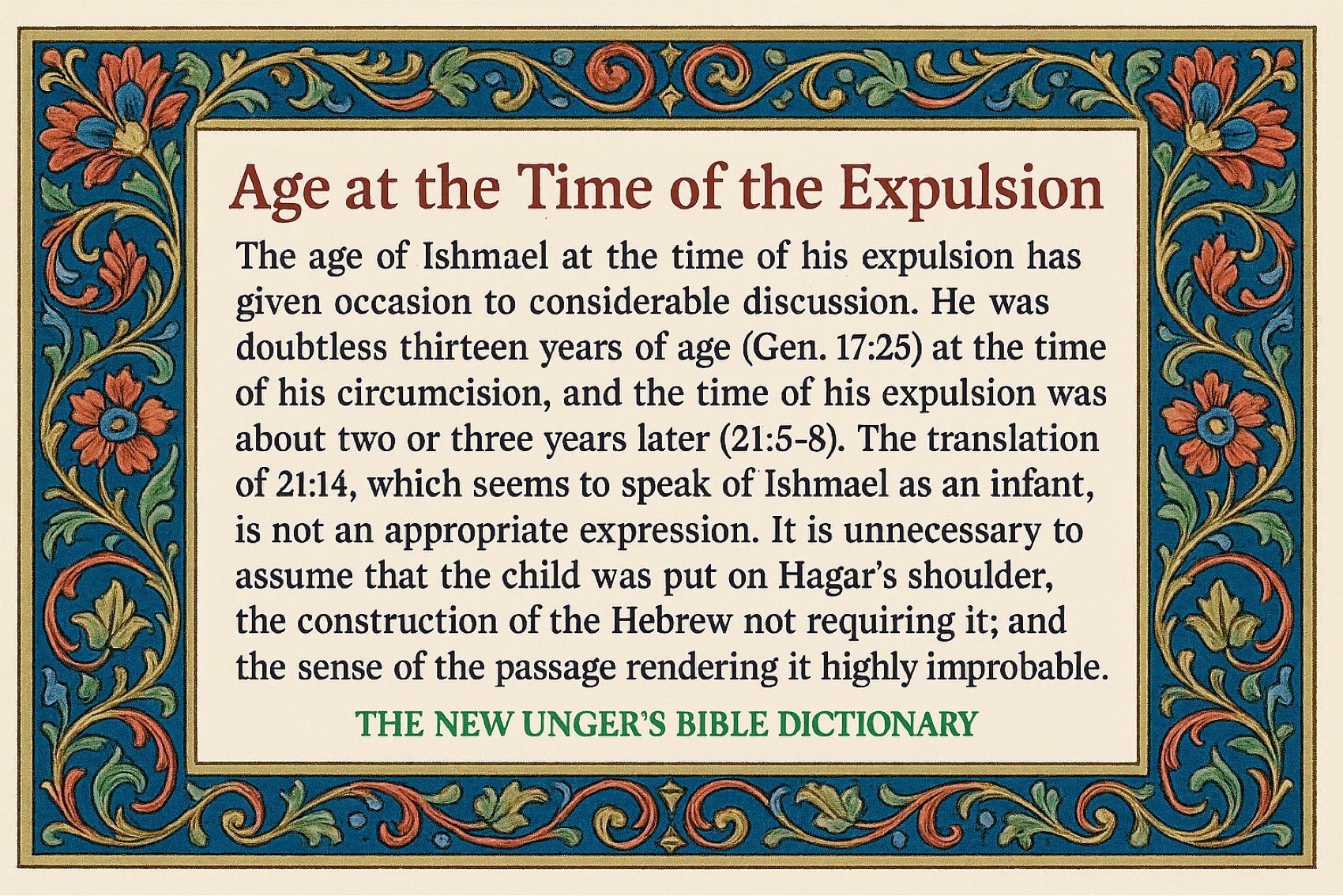
In Genesis 21:14–20, Hagar and Ishmael are sent away into the wilderness—a scene that, in the non-traditional chronology, continues naturally from Genesis 16. At this stage, Ishmael is still an infant, consistent with the Islamic narrative in which Abraham leaves Hagar and her baby near the barren valley of Bakkah (later known as Makkah). The mother’s anguish, the drying of the water skin, and the angelic reassurance all mirror the Islamic version, where divine mercy springs forth in the form of the Zamzam well. In this view, the episode preserves an ancient memory of Ishmael’s early exile and divine deliverance, long before his adolescence and circumcision. The portrayal of the child’s helplessness and the miraculous provision of water thus reflect an authentic recollection of Ishmael’s infancy—his first encounter with divine providence in the wilderness.

The angel’s voice from heaven—“Fear not, for God has heard the voice of the lad”—marks a divine reaffirmation of Ishmael’s destiny. The wilderness ordeal becomes the first stage of a covenantal trial that mirrors Abraham’s own later testing.

This trial reaches its climax in Genesis 22, where Abraham is commanded to offer his “only son.” In the non-traditional chronology, this episode immediately follows Ishmael’s wilderness experience and refers to Ishmael, not Isaac. The parallels between the two chapters—departure, near-death, angelic intervention, divine blessing—form an unmistakable unity. Both episodes concern Ishmael and the same divine purpose: the proving of Abraham’s faith through his firstborn son.

III. Promise Before Ratification: Reordering Genesis 22 and 17

In this reading, Genesis 22 represents the stage of divine promise, while Genesis 17 represents the later ratification of that promise. The theological rhythm follows a familiar biblical pattern: divine favor is spoken before it is institutionally sealed.

After Abraham’s supreme act of obedience in Genesis 22, God swears by Himself:

“Because you have done this thing and have not withheld your son, your only son,

I will surely bless you and multiply your seed as the stars of heaven and as the sand which is on the seashore” (Gen. 22:16–17).
This solemn oath is promissory, forward-looking, and grounded in faith rather than ritual. Only later, in Genesis 17, is the same divine promise formalized into a ratified covenant through circumcision—the ratification that confirms what faith had already secured.

Thus, in the reconstructed chronology, Genesis 22 (promise) precedes Genesis 17 (ratification). The order of theological causality is restored: obedience leads to divine assurance, which then leads to covenantal institution.

IV. Redactional Reversal and the Rise of Isaac

The canonical order of Genesis—where Genesis 17 precedes Genesis 22—reflects a deliberate redactional reversal designed to elevate Isaac’s role as the covenantal heir. In the non-traditional chronology, however, the sequence unfolds differently: Genesis 21:14–20 and Genesis 22 follow directly after Genesis 16, forming a unified Ishmaelite cycle of trial and divine assurance, while Genesis 17 stands later as the formal ratification of the promise that faith had already secured.

In this reading, Genesis 21:14–20 records Ishmael’s early exile into the wilderness—a scene that continues naturally from Genesis 16. At this stage, Ishmael is still an infant, in harmony with the Islamic narrative in which Abraham leaves Hagar and her baby in the barren valley of Bakkah (Makkah). The mother’s anguish, the exhaustion of the water skin, and the angelic reassurance mirror the Qur’anic memory of divine mercy manifested through the spring of Zamzam. The episode thus preserves an ancient recollection of Ishmael’s infant exile and miraculous deliverance, representing his first encounter with divine providence.

The angel’s voice from heaven—“Fear not, for God has heard the voice of the lad”—announces the beginning of Ishmael’s destiny as a nation-bearer. This wilderness trial becomes the first stage of covenantal testing, mirroring the later trial in Genesis 22, where Abraham is commanded to offer his “only son.” In this non-traditional sequence, Genesis 22 immediately follows Ishmael’s wilderness ordeal and refers again to Ishmael, not Isaac. The parallels between the two episodes—departure, near-death, angelic intervention, and divine blessing—form a continuous narrative arc. Both scenes concern the same son and the same divine purpose: the testing of Abraham’s faith through his firstborn.

Yet, in the canonical Genesis, this Ishmaelite cycle has been recast. By portraying Ishmael as a marginal episode and substituting Isaac into the near-sacrifice narrative, the redactor transformed the theological center of the story. The covenantal promise once bound to Ishmael’s faith and deliverance was redirected to Isaac’s election. Nevertheless, subtle traces of the older Ishmaelite tradition remain—visible in the angelic interventions, the duplicate promises of blessing, and the recurring description of the “only son.”

V. Theological Implications

Under this restored chronology, Ishmael emerges as the original figure of faith and trial—the child of promise who experiences divine testing before covenantal ratification. His infancy in the wilderness becomes the prelude to the greater trial of obedience on the mountain. The “promise before ratification” pattern reaffirms the divine order that pervades Scripture: Noah finds favor before covenant (Genesis 8–9), Moses receives his call before Sinai (Exodus 3–19), and here, Abraham’s faith through Ishmael precedes the covenant of circumcision in Genesis 17.

This theological structure restores the primacy of faith preceding law, and of divine promise preceding institution. Ishmael’s story thus reveals an ancient, universal rhythm of revelation—one in which God’s mercy and testing lead to covenantal confirmation, rather than the other way around.

In this view, Ishmael is not a peripheral figure but the first manifestation of Abrahamic faith, the forerunner of prophetic endurance and submission (islām). His deliverance in the desert and his near-sacrifice on the mountain form a unified testimony of divine providence and human obedience—a covenantal relationship established not through birthright, but through trial and trust.

Conclusion

The non-traditional chronology, placing Genesis 21:14–20 and Genesis 22 immediately after Genesis 16, and understanding Genesis 22 (promise) as preceding Genesis 17 (ratification), restores narrative coherence and theological depth to Ishmael’s story. It reunites his infancy, trial, and divine deliverance into a single arc of faith, thereby recovering the early Abrahamic tradition in which the covenant arises as the fruit of obedience, not its prerequisite.

Seen through this lens, the covenant with Abraham becomes not the exclusive inheritance of Isaac but the culmination of a universal divine pattern—one that begins with Ishmael, the firstborn of faith, whose endurance and trust in the wilderness and on the mountain prefigure the submission that would later define the very essence of Abrahamic monotheism.
Does the Promise of a “Son from Your Own Body” Refer to Ishmael?

📜 Reassessing Genesis 15:4:

Does the Promise of a “Son from Your Own Body” Refer to Ishmael?

Abstract

Genesis 15:4 contains God’s foundational promise to Abraham that his heir will be “a son from your own body.” While Jewish and Christian tradition identifies this promised son as Isaac, an examination of the narrative order, the literal Hebrew wording, and source-critical insights suggests that the earliest and most natural fulfillment of this promise is Ishmael, Abraham’s firstborn. This article re-evaluates Genesis 15:4 through textual, historical, and Islamic perspectives to explore whether the promise originally referred to Ishmael before later priestly reinterpretation.


📘 1. Introduction

In Genesis 15, Abraham expresses deep concern about his lack of a biological heir and assumes his servant Eliezer will inherit his estate. God responds decisively:

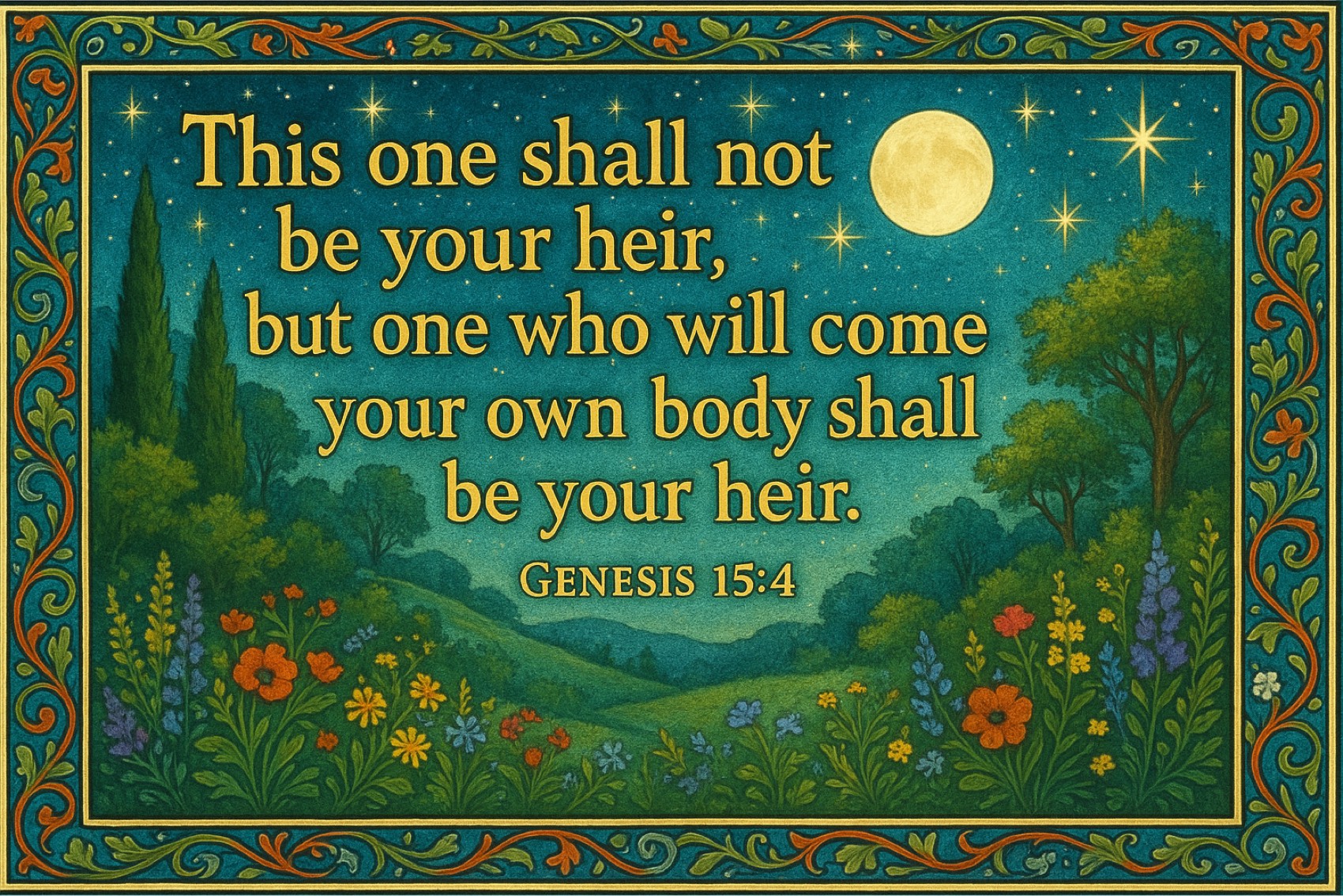
“This one shall not be your heir, but one who will come from your own body shall be your heir.”
(Genesis 15:4)
At this point in the narrative:

• Sarah has not yet given birth,
• Isaac has not yet been announced, and
• Ishmael has not yet been conceived.

The promise is therefore open and unnamed. The very next chapter, Genesis 16, introduces Hagar and narrates the birth of Ishmael—Abraham’s first biological son, who literally fulfills the condition of Genesis 15:4.

This raises a critical theological and textual question:

If Genesis 15:4 does not refer to Ishmael, then whose son is Ishmael, and why does Ishmael perfectly fulfill the verse?


📘 2. The Wording of Genesis 15:4

The Hebrew phrase “yēṣēʾ mimmeʿêkā” (יֵצֵ֣א מִמֵּעֶ֔יךָ ) translates:

“One who comes forth from your own body/loins.”

Three observations are decisive:

The promise does not mention Sarah — only Abraham’s biological paternity is required.

The child is not named — the reader is left waiting for a son born to Abraham.

The promise precedes the Isaac announcement — Isaac appears only two chapters later.

Therefore, the literal sense of the verse is broad enough to include any biological son of Abraham, and chronologically, Ishmael is the first and only son who fulfills it.


📘 3. Narrative Logic: Ishmael as Immediate Fulfillment

If Genesis 15:4 is interpreted as not referring to Ishmael, the text becomes internally incoherent.

The promise requires:

• a biological son,
• born after the promise,
• replacing Eliezer as heir.

Ishmael meets all three criteria:

• He is Abraham’s biological son.
• He is born immediately after the promise (Genesis 16).
• He becomes Abraham’s heir prior to the Isaac narrative.

Thus, if the verse does not refer to Ishmael, one must logically deny Ishmael’s biological connection to Abraham—a contradiction of the text.

Therefore:

Ishmael is the natural and immediate fulfillment of Genesis 15:4.

Isaac’s role emerges much later, within a new covenantal framework introduced in Genesis 17.


📘 4. Canonical vs. Text-Critical Interpretations

4.1 The Canonical Interpretation (Jewish & Christian)

According to the narrative order of Genesis as preserved in the Bible:

• Genesis 16 records the birth of Ishmael—the first son born after the promise of a “son from your own body.”
• Genesis 17 follows, when Ishmael is already 13 years old; here God announces Isaac for the first time and assigns the covenant to him.
• Genesis 21 narrates the birth of Isaac.

Because Isaac’s covenantal role is introduced only after Ishmael’s birth, Jewish and Christian tradition retroactively reads Genesis 15:4 as referring to Isaac—even though Ishmael is the first and literal fulfillment of that promise.

4.2 The Pre-Priestly Source (J/E) Interpretation

Historical-critical scholarship proposes that Genesis 15 belongs to an earlier narrative layer in which Ishmael played the role of Abraham’s primary heir.

Key scholars (Friedman, Sarna, Westermann) have observed:

• Genesis 15 is older, J/E (non-priestly) material.
• Genesis 17 is priestly (P) and reflects later theological concerns.
• The priestly layer shifts privilege from Ishmael to Isaac.

Thus:

In the earlier narrative tradition, Ishmael appears to be the intended heir of Genesis 15.
The priestly editor later reinterpreted this promise toward Isaac.

This aligns seamlessly with the Islamic view, where Ishmael is the firstborn heir prior to Isaac’s later covenantal role.


📘 5. The Islamic Perspective

Islam teaches that Ishmael is Abraham’s firstborn and rightful heir. The Qur’an positions Ishmael and Abraham together in key covenantal acts—building the Kaaba, dedicating it to God, and establishing the monotheistic legacy continued by Muhammad ﷺ.

Within this framework, Genesis 15:4 is perfectly consistent with Ishmael’s role:

• He is Abraham’s first biological son,
• the heir “from your own body,”
• and the son through whom Abraham’s first trials occur (desert episode, near-sacrifice in Islamic tradition).

Therefore:

From an Islamic view, Genesis 15:4 is a clear anticipation of Ishmael’s birth.


🌟 6. Conclusion

📝 Genesis 15:4 promises that Abraham’s heir will be a son “from your own body.” When read in its chronological context, this promise applies directly to Ishmael, whose birth is recorded in Genesis 16, the only son born after the promise and before the later covenantal reinterpretation of Genesis 17.

🔔 Therefore, on narrative, chronological, and source-critical grounds, Genesis 15:4 is best understood as originally referring to Ishmael—Abraham’s firstborn son. Only later, through priestly redaction in Genesis 17, is Isaac elevated to the center of the covenantal narrative, reshaping the earlier storyline.

This reading harmonizes the biblical narrative with Islamic tradition and offers a compelling reinterpretation of the Abrahamic story grounded in textual coherence and historical analysis.

🕋 The Abrahamic Covenant and the Sinai Covenant: An Islamic Perspective

Introduction

In the history of divine revelation, few themes are as central as the notion of covenant—a sacred bond between God and humankind. Both Judaism and Islam trace their spiritual origins to Abraham (Ibrāhīm عليه السلام), yet they diverge significantly in how they interpret the continuity and authority of that covenant. While Jewish tradition venerates the Ark of the Covenant (Aron ha-Berit) as the central relic of divine presence, Islam maintains a living connection to Abraham through enduring symbols such as the Kaaba (House of God), the Black Stone (Hajar al-Aswad), and the Station of Abraham (Maqām Ibrāhīm).

From an Islamic standpoint, this difference reflects not merely a matter of heritage, but a profound theological distinction between two divine covenants: the Abrahamic and the Sinai.


The Abrahamic Covenant and the Sinai Covenant
The Abrahamic Covenant represents God’s original and universal promise to Abraham—offering him descendants, land, and blessings for all nations (Genesis 12, 15, 17). It is viewed in Islam as the foundation of true monotheism and moral submission (islām).

In contrast, the Sinai Covenant (or Mosaic Covenant) was established later with the Israelites through Moses (Mūsā عليه السلام) at Mount Sinai. This covenant centered on the Law (Torah) and bound a particular nation to divine commandments. Islamic scholars interpret this as a temporary covenant intended to guide a specific community until the restoration of the universal Abrahamic faith.


Continuity and Fulfillment in Islam
Islamic theology asserts that Muslims are the true inheritors of the Abrahamic Covenant. This covenant, described as universal and eternal, transcends tribal or ethnic boundaries. It was renewed and fulfilled through Prophet Muhammad ﷺ, a direct descendant of Abraham through Ishmael (Ismāʿīl عليه السلام).

In contrast, the Sinai Covenant is seen as particular and conditional—its blessings dependent on Israel’s obedience to divine law. When that law was broken and the Ark of the Covenant lost, Islamic scholars view it as symbolizing the closure of that covenantal phase.


The Significance of Relics and Continuity of Faith
A striking contrast between Judaism and Islam lies in the preservation of relics tied to their covenantal heritage.

• Judaism possesses no surviving Abrahamic relic; the Ark of the Covenant—the holiest object of ancient Israel—was associated with Moses, not Abraham, and disappeared after the First Temple’s destruction.

• Islam, by contrast, maintains tangible Abrahamic relics: the Kaaba (House of God), built by Abraham and Ishmael; the Black Stone, believed to mark God’s covenantal witness; and the Station of Abraham, where he stood during construction of the Kaaba.

Islamic scholars often interpret this continuity of relics as an enduring testimony that Islam preserves the living Abrahamic legacy in both spirit and form.


The Ark of the Covenant and the End of the Sinai Order
The Ark of the Covenant served as the focal symbol of God’s presence in Israelite religion, containing the stone tablets of the Law revealed to Moses. However, its loss during the Babylonian destruction of the First Temple is understood in Islamic thought as emblematic—the withdrawal of divine favor from a covenant that had fulfilled its temporal purpose.

In contrast, Islam views the Kaaba as the restored House of God (Bayt Allāh), representing a continuous line of divine worship from Adam to Abraham and finally to Muhammad ﷺ.

The Ark belonged to the age of law, but the Kaaba belongs to the age of unity. The former was carried by priests; the latter is circled by all believers.


Lineage and Restoration of the Original Faith
Islamic scholarship emphasizes that Prophet Muhammad ﷺ descends from Abraham through Ishmael, preserving the original monotheistic lineage. This genealogical link reinforces Islam’s claim as the restoration, rather than innovation, of Abraham’s faith.

Thus, Islam positions itself not as a new religion but as the revival of the primordial covenant—the same faith of Abraham, purified from human distortions and reaffirmed for all nations.


Universality and Particularity
Theologically, Islam presents the Abrahamic Covenant as universal, extending to all humanity through submission to one God. By contrast, the Sinai Covenant is viewed as particular, restricted to the Israelites and their historical experience.

This distinction underscores Islam’s claim that the divine message, once localized in Israel, has now been universalized through the final revelation of the Qur’an—fulfilling God’s promise to make Abraham “a father of many nations” (Genesis 17:5).


Supersession and Fulfillment
Some Islamic interpretations express a form of supersessionism, not in the sense of replacement but of completion. The Qur’an acknowledges earlier covenants while affirming that final guidance was perfected in Islam:

“This day I have perfected your religion for you, completed My favor upon you, and chosen Islam as your way.”
(Qur’an 5:3)
Thus, the Abrahamic Covenant, renewed through Muhammad ﷺ, is seen as the culmination of God’s redemptive plan that began with Abraham and reached universality through Islam.


Conclusion

The Islamic distinction between the Abrahamic and Sinai covenants is not merely historical but profoundly theological. The loss of the Ark, the absence of Abrahamic relics in Judaism, and the survival of the Kaaba and the Station of Abraham in Islam are read as symbolic of a divine transition—from the particular to the universal, from the Mosaic to the Abrahamic, from the temporal to the eternal.

In the eyes of Islamic scholarship, the covenant lives on not in a lost ark of gold, but in the living hearts of those who submit to God in the faith of Abraham—the father of all who believe.