🕊️ Is Isaac or Ishmael the Child Entrusted to and Consecrated to God?

A Comparative Theological Reflection

📜 The question of whether Isaac or Ishmael is the child entrusted and consecrated to God lies at the heart of divergent Abrahamic narratives. While the Biblical tradition, particularly as preserved in the Masoretic text, presents Isaac as the covenantal heir, the Qur’anic and Islamic theological framework portrays Ishmael as the son whose life was dedicated to God from infancy. This distinction is not merely genealogical; it reflects fundamentally different understandings of consecration, trial, and divine trust.

🌿 In Islamic theology, Ishmael is depicted as a child placed directly under God’s guardianship at the very beginning of his life. By divine command, Abraham leaves Hagar and the infant Ishmael in a barren valley—later known as Becca or Mecca. This act is not abandonment but entrustment. Deprived of human protection, Ishmael survives only through divine intervention, most notably the emergence of the Zamzam spring. His upbringing thus unfolds under God’s immediate care rather than within Abraham’s household authority.

📖 Significantly, even the Bible acknowledges this divine guardianship in Genesis 21:20: “God was with the boy.” This concise statement carries deep theological weight. It signals not merely blessing, but active divine presence—an indication that Ishmael’s life is sustained and guided directly by God. Such language is rare in the Biblical narrative and reinforces the notion of consecration through divine custody.

🔥 This early entrustment reaches its climax in the episode of sacrifice. In the Qur’anic account (Qur’an 37:102), the son—understood in Islamic tradition to be Ishmael—responds to Abraham’s vision with calm submission, willingly accepting God’s command. His readiness reflects a lifelong formation in obedience, making the act of sacrifice the culmination of a consecrated life rather than an isolated test.

🕋 Moreover, the Qur’an explicitly pairs Abraham and Ishmael in the sanctification of the House of God. In Surah al-Baqarah (2:125), both are commanded to purify the sacred sanctuary for worshippers. This shared responsibility situates Ishmael not only as a passive recipient of God’s care, but as an active participant in establishing sacred space and ritual—hallmarks of covenantal service.

🌸 By contrast, Isaac is portrayed differently. His birth is miraculous and joyful, described as a divine gift to Abraham and Sarah after long years of waiting. Isaac grows up within Abraham’s household, under parental protection, and without the same wilderness trials that define Ishmael’s early life. In the Biblical narrative, Isaac becomes central in Genesis 22, the binding (Akedah), where Isaac is presented as the intended sacrificial son, yet this episode stands largely alone. It is not consistently integrated into the later Hebrew Bible or into broader biblical theology as a defining moment of lifelong consecration.

📚 From an Islamic perspective, this difference is decisive. Ishmael represents the son of sacrifice—formed through trial, trust, and submission from infancy—while Isaac represents the son of blessing, granted as a reward after Abraham’s obedience has already been proven. Consequently, Islamic theology maintains that true consecration is demonstrated through sustained entrustment to God, not solely through lineage or a single dramatic episode.

✨ In conclusion, when consecration is understood as a life placed under divine trust, shaped by trial, and fulfilled through submission and sacred service, Ishmael emerges as the child truly entrusted to God. Isaac remains honored and blessed, yet it is Ishmael whose life narrative consistently reflects devotion from infancy to maturity. This distinction underpins the Qur’anic claim that the original Abrahamic legacy is carried forward through Ishmael—a legacy ultimately reaffirmed and universalized in Islam.

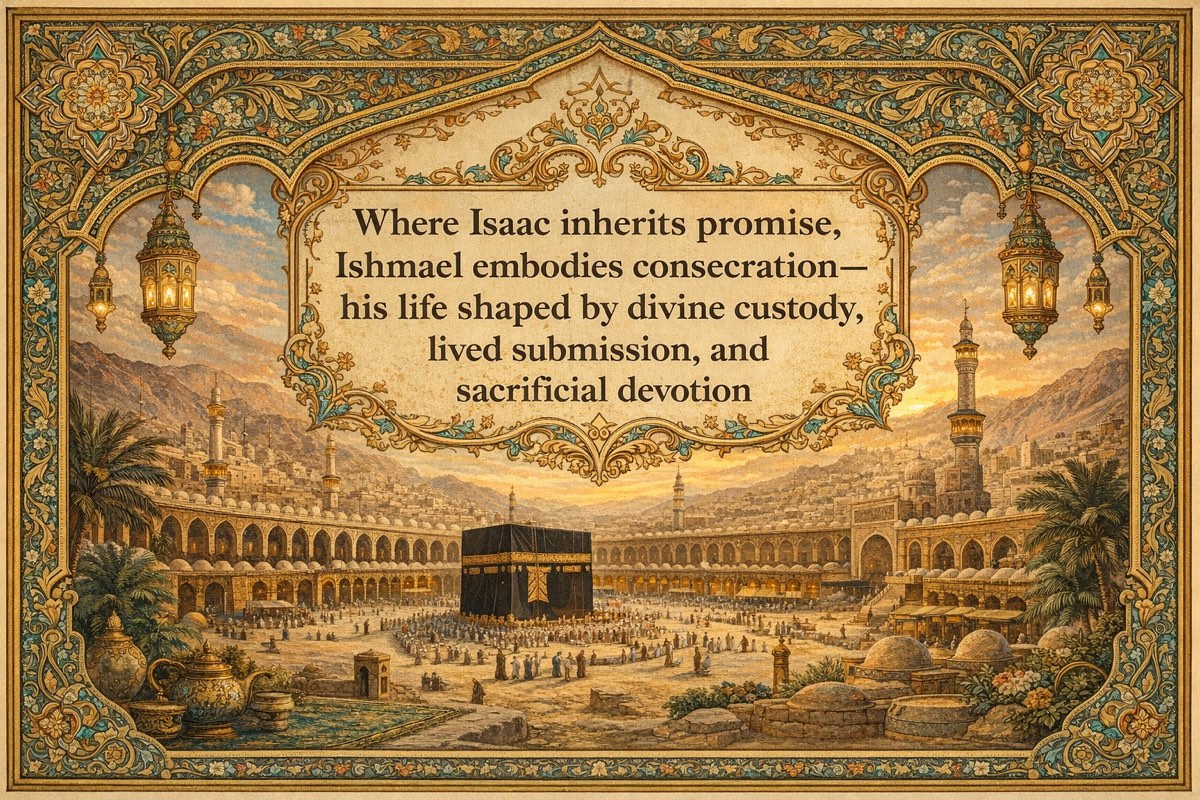
✨ Where Isaac inherits promise, Ishmael embodies consecration—his life shaped by divine custody, lived submission, and sacrificial devotion ✨

This statement presents a theological and literary re-reading of the biblical and Qur’anic figure Ishmael, challenging the traditional Judeo-Christian focus on Isaac as the primary child of promise. Let’s break down the meaning and implications of each part:

“Ishmael—not Isaac—is the child consistently portrayed as entrusted, devoted, and consecrated to God.”

This claim re-centers Ishmael as the child who embodies the qualities of being:
• Entrusted (given into God’s care or purpose),
• Devoted (loyal and faithful to God’s will), and
• Consecrated (set apart for sacred purpose).

It suggests that, contrary to conventional narratives, Ishmael—not Isaac—fulfills the spiritual role of the true servant of God. This reading aligns more with Islamic tradition, where Ishmael (Isma’il) is seen as a prophet and the one nearly sacrificed by Abraham, rather than Isaac (as in Jewish and Christian traditions).

⸻

👶 1. “His life begins in divine custody.”

This likely refers to how Ishmael’s life begins under divine providence from the start:

• In Genesis 16, before Ishmael is even born, God speaks to Hagar (his mother), naming the child Ishmael (“God hears”) and promising that he will be the father of a great nation.
• When Hagar and the infant Ishmael are cast into the wilderness (Genesis 21), God hears their cries and intervenes directly, saving Ishmael and reaffirming his destiny.
• This divine protection from infancy is interpreted as a form of “custody”—God personally watching over and guiding Ishmael’s life.

In Islamic tradition, this divine care continues. Ishmael and his mother are considered to have been purposefully guided to Mecca, where Ishmael grows under God’s plan.

⸻

🙏 2. “His faith is proven through lived submission.”

This line points to Ishmael’s active obedience and spiritual submission, especially in the story of the near-sacrifice:

• In Islamic tradition (Qur’an 37:102–107), it is Ishmael (not Isaac) who is the son Abraham is commanded to sacrifice.
• Significantly, Ishmael consents to the sacrifice. When Abraham tells him of the vision, Ishmael replies:
“O my father, do as you are commanded. You will find me, if Allah wills, among the steadfast.” (Qur’an 37:102)

This response is seen as a model of submission (Islam itself means “submission to God”). Ishmael is not just passively involved—he willingly submits, embodying perfect faith and trust in God.

⸻

🕋 3. “His consecration culminates in sacrifice and sacred service.”

Here, the statement draws on the idea that Ishmael’s life mission is sealed through:

• The near-sacrifice, which is both a test and a sacred act.
• His later life, which (according to Islamic tradition) includes:
• Helping build the Kaaba (House of God) with Abraham (Qur’an 2:127),
• Serving as a prophet and guide to his people,
• Being the spiritual ancestor of the Prophet Muhammad, and thus playing a key role in sacred history.

In this view, Ishmael’s entire life trajectory—his birth, testing, and later mission—is understood as one long arc of consecration to divine service.

⸻

📌 Summary

This interpretation of Ishmael:

• Challenges the typical Judeo-Christian emphasis on Isaac as the heir of God’s promise.
• Highlights Ishmael’s active, faithful, and sacrificial role in God’s plan.
• Resonates particularly with Islamic theology, where Ishmael is a revered prophet, an obedient servant, and central to the sacred narrative.

Thus, the statement offers a re-evaluated spiritual reading of Ishmael—one that casts him not as the rejected or secondary son, but as the true exemplar of entrusted devotion and consecrated submission to God.
📜 Who Wrote the Book of Genesis?

Tradition, Scholarship, and the Ongoing Debate

The question of authorship of Book of Genesis has long occupied both religious tradition and modern biblical scholarship. Unlike many ancient texts, Genesis does not identify its author within its own pages. Nor does any other book of the Bible explicitly name who wrote it. This absence has created a fertile ground for interpretation, debate, and evolving theories across centuries.

🕊️ The Traditional Attribution to Moses

Within Jewish and Christian tradition, Genesis has historically been attributed to Moses. This view did not arise arbitrarily. The remaining books of the Torah (or Pentateuch), such as Exodus, Leviticus, Numbers, and Deuteronomy, explicitly associate Moses with their composition, and biblical literature consistently treats the Torah as a unified body of sacred law and narrative. As a result, it was natural for ancient interpreters to regard Moses as the author of the entire collection, including Genesis.

There is also a compelling symbolic logic to this attribution. Moses, as the lawgiver and central prophetic figure of Israel’s formative period, seemed the most fitting individual to compile the book that narrates the origins of creation, humanity, and Israel itself. As has often been remarked, who better to write the book of beginnings?

🔍 The Limits of Tradition and the Rise of Critical Inquiry

Yet when tradition is set aside and the question is approached through historical and textual analysis, the evidence linking Moses directly to the writing of Genesis proves difficult to substantiate. The text of Genesis itself offers no explicit claim of Mosaic authorship, and internal features—such as shifts in style, vocabulary, and theological emphasis—have raised questions among scholars.

Over the past century, much academic scholarship has gravitated toward source criticism, a method that proposes Genesis is composed of multiple literary sources rather than a single author. These sources are often dated to the late pre-exilic and early post-exilic periods, long after the time traditionally associated with Moses. According to this view, Genesis reflects layers of tradition shaped and preserved over generations before being compiled into its present form.

đź§  Challenges to Source Criticism

Despite its influence, source criticism has not gone unchallenged. Advances in computer-assisted linguistic analysis have questioned whether the stylistic criteria used to separate sources are as reliable as once assumed. These studies suggest that variations in language may not necessarily indicate multiple authors, but could instead reflect genre, subject matter, or editorial purpose.

At the same time, alternative approaches such as redaction criticism have gained prominence. Rather than focusing primarily on identifying hypothetical sources, redaction criticism examines how the book was edited, arranged, and shaped into a coherent narrative. This perspective shifts attention from who wrote Genesis to how Genesis was formed and why it was structured in its final form.

📚 An Open Question Without a Final Answer

What emerges from this long history of debate is not a definitive conclusion, but a recognition of complexity. There is no shortage of theories regarding the authorship and composition of Genesis, and no single model has achieved universal acceptance. Tradition offers coherence and continuity; critical scholarship offers analytical depth and historical sensitivity. Each approach highlights different dimensions of this foundational text.

In the end, the authorship of Genesis remains an open and evolving question—one that continues to invite dialogue between faith, history, and literary study. Far from diminishing the book’s significance, this ongoing inquiry underscores its richness and enduring power as a text that has shaped religious thought for millennia.